
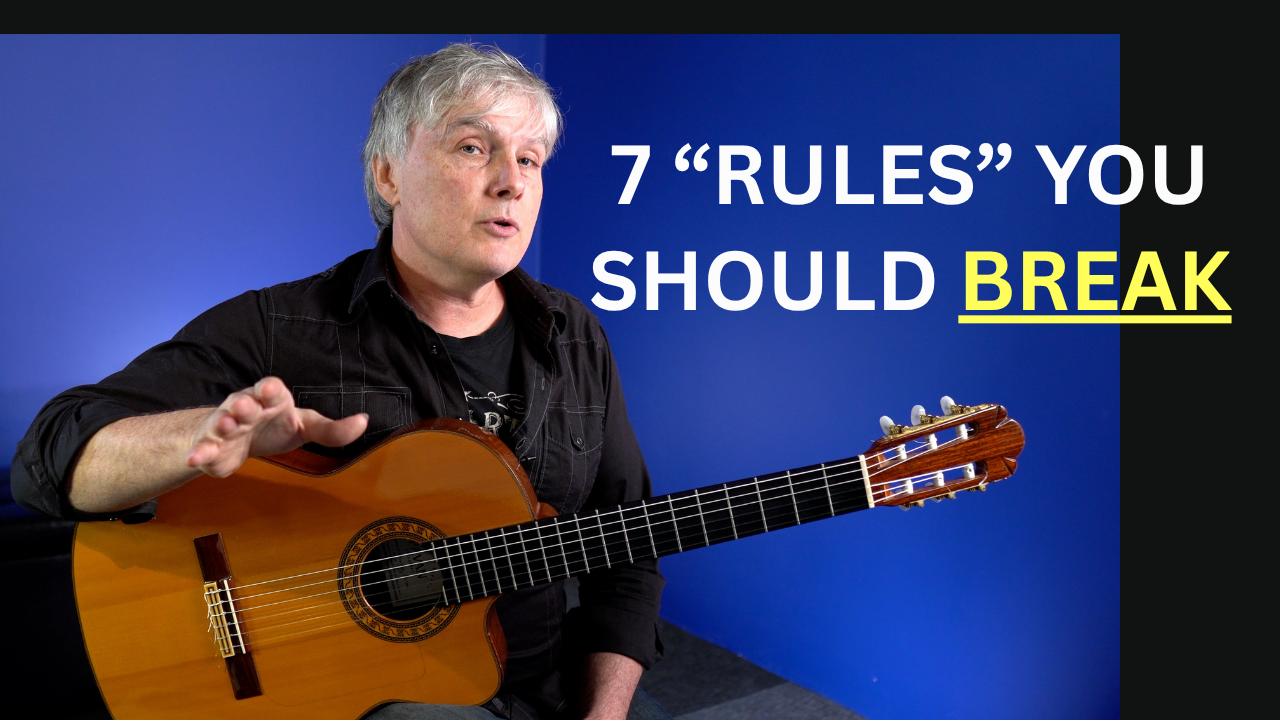
Lies Your Classical Guitar Teacher Told You
Jun 08, 2026
7 Lies Your Classical Guitar Teacher Told You (And Why They're Holding You Back)
Let's be honest — most classical guitar "rules" were never meant to be rules at all.
What usually happens is this: a well-meaning teacher offers a helpful guideline, and the student takes it as gospel. An unchangeable law. And before long, that guideline becomes a mental barrier standing between you and the music you want to play.
In this blog post I walk through seven of the most common myths I encounter in classical guitar — notions I want to help you unlearn so you can learn faster, play better, and become a more versatile guitarist.
Myth #1: Tablature Is Evil
Classical guitarists tend to hold this opinion more strongly than players of almost any other style. Tablature gets dismissed as a shortcut — even as cheating.
But here's some perspective: tablature-style notation systems have existed since the Renaissance. It's a tool. And a good one.
Reading standard notation on guitar is genuinely difficult — partly because of all the redundant notes. If you see an E written in standard notation, which E is it? You need additional notation just to specify the string. Tablature cuts straight to the point.
That said, I'm not anti-notation. Learning to read music — especially rhythmic notation — is a worthy long-term goal. But don't let the absence of that skill stop you from playing and having fun right now. Many classical guitarists will quietly admit they read tablature 90% of the time anyway. You're not lesser of a musician for using it.
Myth #2: Your Fingers Are Assigned Specific Strings
This one I hear constantly from students who've worked with other teachers. The idea is that your ring finger lives on the first string, middle on the second, index on the third, and thumb handles the bass strings — and that's that.
But spend five minutes with a piece like Malagueña and you'll already be playing your thumb on the B string. In flamenco, the thumb regularly plays the first string for its distinct tonal quality. In picado passages, your index or middle finger might travel all the way down to the bass strings.
The goal is simple: any finger, any string, any time, for any musical reason. That's the freedom you're after.
Myth #3: Your Knuckles Must Be Parallel to the Strings
The classical hand position - knuckles parallel to the strings - makes more sense when you're sitting in the traditional classical position with the guitar elevated on the left leg. But it isn't a universal law.
Most of the time, a slight diagonal angle actually produces a better sound. It allows you to attack the string at a softer trajectory, which gives you a warmer, rounder tone. Playing with your knuckles perfectly parallel tends to produce a harsher, more brittle sound — and makes it easier to catch your nail on the strings.
There are exceptions: tremolo technique, for instance, benefits from a more parallel position because you need to navigate the narrow spaces between strings. But for general playing? A slight slant is often the better choice.
Myth #4: You Need Long Fingernails to Play Classical Guitar
Students say this all the time — and it simply isn't true. In fact, nails that are too long make playing harder, not easier.
Pepe Romero famously suggested that beginners shouldn't use any nails at all during their first year of playing. Lute players often perform with very short or no nails, which allows for a more direct connection with the string and better grip.
The sweet spot: just long enough to add a little volume and clarity, but not so long that they become an obstacle. Overgrown nails are constantly changing, constantly catching, and constantly getting in the way. Keep them modest.
Myth #5: You Have to Sit in the Classical Position
The traditional classical position — guitar on the left leg, left foot on a footstool — goes back to Francisco Tárrega. And yes, there are genuine ergonomic reasons for it. But it's not the only way.
More and more accomplished classical players are opting for the guitar on the right leg. Nearly every flamenco guitarist sits this way. The key principle — elevating the leg to bring the guitar to a better angle — can be applied regardless of which leg you use.
What matters most is that you're comfortable, relaxed, and positioned in a way that serves the music you're playing. Experiment with different positions. A crossed leg, a foam support, a stack of books — whatever works for your body and your playing.
Myth #6: You Must Learn to Read Music
Reading standard notation is valuable. I genuinely recommend working toward it — the rhythmic literacy alone is worth the effort, and it opens doors into music theory that are otherwise harder to access.
But it is not a gatekeeper.
Music existed long before notation. Some of the most harmonically sophisticated jazz musicians in history are not strong readers. Paul McCartney claims he can't read music. Many of the legendary flamenco guitarists of the past learned entirely by ear, imitation, and feel — no method books, no notation, no footstools.
If you have adult students who don't want to read music, the answer isn't to turn them away. The answer is to meet them where they are and help them make music. That's what it's about.
Myth #7: You Must Learn Classical Guitar Before Flamenco, Bossa Nova, or Other Nylon String Styles
This one often comes from teachers who simply don't teach those other styles — so they tell students they need classical first. That's understandable, but it isn't true.
Yes, there's significant technique overlap between classical and flamenco. But bossa nova, for example, is in many ways technically simpler on the right hand — a lot of block chords, rhythmic pattern work, and chord melody. You don't need a classical foundation to get there.
The flamenco masters of the past didn't study classical guitar. They didn't sit with a footstool, work through Carcassi études, or learn to read music. They started playing the music they loved and became extraordinary guitarists.
My philosophy: start with what excites you most. Not because it's easy — but because enthusiasm and joy are what drive real progress.
The Real Takeaway
These weren't really lies. They were guidelines that got mistaken for commandments.
The overall message of classical guitar — and nylon string playing broadly — should be one of freedom and expressiveness, not rigidity. Too many players get shut out before they ever really begin because they think they're doing it wrong.
You're not doing it wrong. Play the music you love, use the tools that work for you, and keep getting better.

